

- This event has passed.
Reprogramming How We Interface with the Human Body: High-Resolution 3D Printing Can Make the Unmakeable
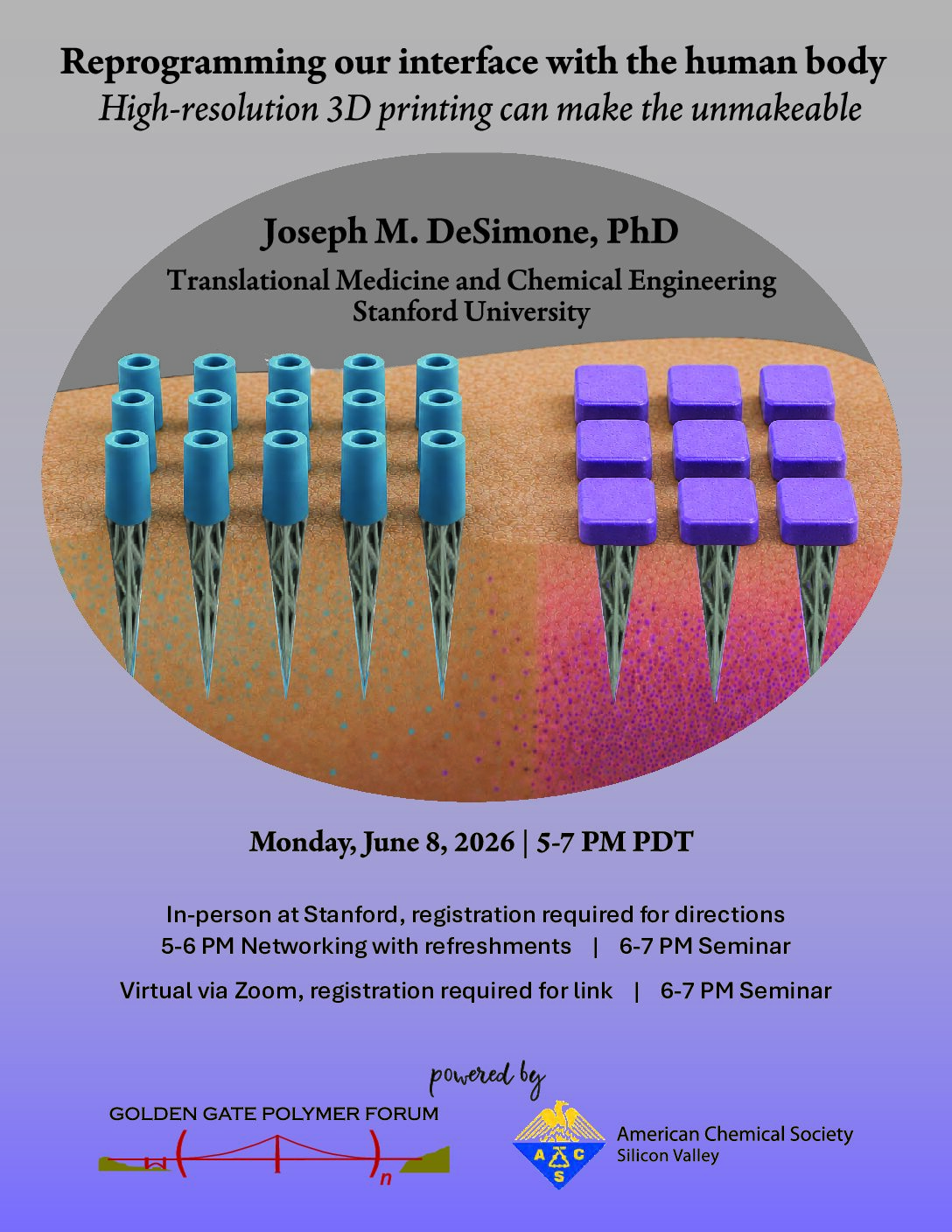
- Prof. Joseph M. DeSimone, Departments of Radiology and Chemical Engineering, Stanford University
The seminar on Monday, June 8, starts at 6:00 PM Pacific time.
An in-person networking hour on the Stanford campus precedes the live presentation from 5:00 – 6:00 PM. - Registration required for campus location or for Zoom link. Registration deadline: Sunday, June 7, 1:00 PM.
Abstract
Throughout my career, I’ve been guided by the belief that transformative advances in medicine don’t arise solely from new molecules, but equally from rethinking how those molecules are formulated and delivered to the body. This mindset has led to a series of unconventional dosage and delivery innovations—from biodegradable drug-eluting stents (BVS, Inc., acquired by Guidant and now part of Abbott; co-founded with Bob Langer), to precisely engineered microparticles for inhalation (Liquidia Technologies; NASDAQ: LQDA), to iontophoretic platforms for localized chemotherapy (Focal Medical; IND approved by the FDA, with patients treated beginning March 2026)—each opening new therapeutic frontiers.
Today, advances in high-resolution 3D printing are enabling a new chapter in this journey: the ability to engineer the skin as a programmable biological interface. Using microscale additive manufacturing, we can create intradermal delivery systems that precisely control where and how therapeutics are introduced, while simultaneously enabling access to rich biological information through interstitial fluid.
This bi-directional paradigm—delivering therapies while sampling biology—opens a fundamentally new approach to medicine. By targeting the skin and its underlying lymphatic network, we can more effectively engage the immune system, access early disease signals, and move beyond traditional blood-based diagnostics toward continuous, minimally invasive liquid biopsy.
Importantly, this is not simply a new device or formulation—it represents a scalable platform. Rather than building a traditional therapeutic pipeline molecule by molecule, these technologies enable a delivery-centric model that can be applied broadly across vaccines, biologics, and diagnostics.
In this talk, I will outline how focusing on new dosage delivery forms and new devices for liquid biopsies—now powered by high-resolution 3D printing—is redefining our interface with the human body, transforming both how we treat disease and how we measure health.
Speaker Background
Joseph M. DeSimone
Sanjiv Sam Gambhir Professor of Translational Medicine and Chemical Engineering
Departments of Radiology and Chemical Engineering
Department of Chemistry (by Courtesy)
Department of Materials Science & Engineering (by Courtesy)
Graduate School of Business (by Courtesy)
Stanford University
Prof. DeSimone is widely known by the Bay Area polymer science community and the academic world, and his background, interests, and accomplishments are extensive and wide-ranging, and far too long to fit in this note. For further information, please see Stanford links:
Stanford Profile: https://profiles.stanford.edu/joseph-desimone
Research Group Website: https://desimonegroup.stanford.edu